




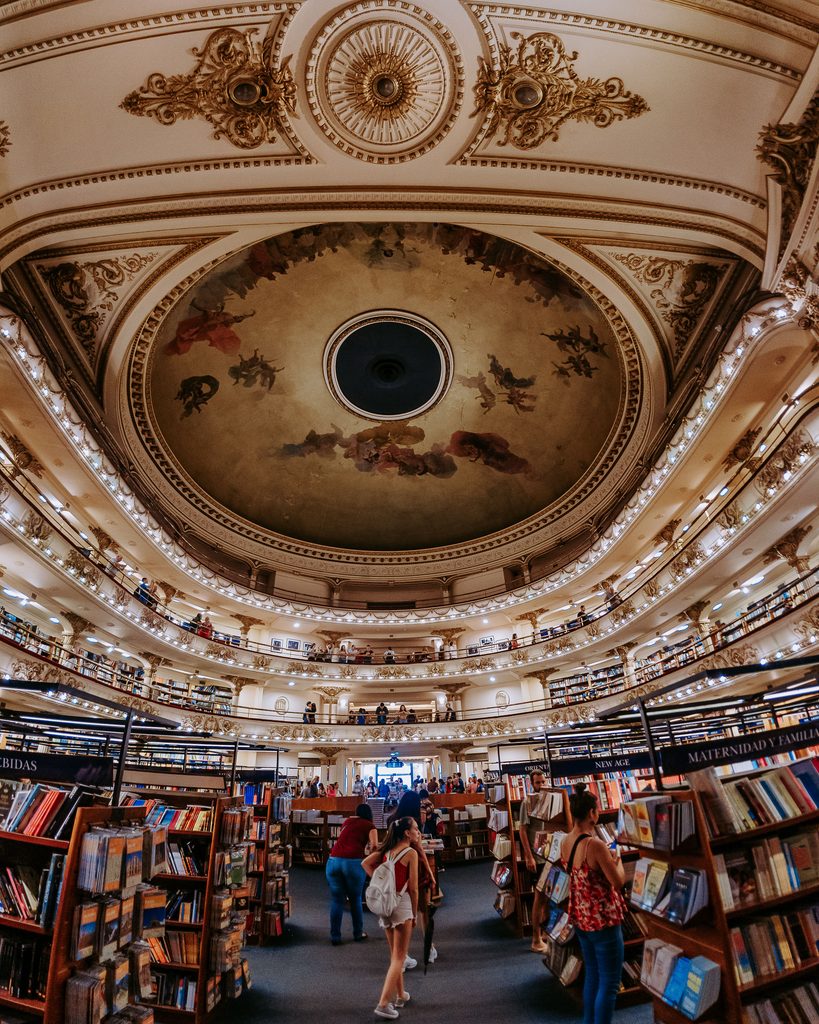
On Avenida Santa Fe in Buenos Aires, roughly 3,000 people a day enter a bookshop and look up before touching a book. The painted dome above them dates back to 1919, when the building opened as a theatre, turning the opening moments of each visit into an act of not shopping.
That minute captures the problem facing physical bookshops after the rise of online retail: selection, price and delivery moved online, but the room stayed put. So the room got serious. Over the past two decades, ambitious bookshops have transformed banks, churches and theatres into spaces for books, while others have built new stores with the scale and ambition of civic buildings. Here are nine of them, and what each one is quietly arguing.
Boekhandel Dominicanen, Maastricht, Netherlands

For much of the twentieth century, this was where Maastricht parked its bikes. The Gothic church was consecrated in 1294 and lost its religious function in 1794, when the French army took the city. It went on to serve as a cavalry stable, a city depot, an exhibition hall and a carnival venue before the bicycles moved in. Boekhandel Dominicanen opened inside it in December 2006. The architects, Merkx+Girod, solved the problem of a space that could not be sensibly subdivided by building a three-story walk-in bookcase in black steel and pushing it down one side only, leaving the opposite side at full height.

Sadly, the parent chain went bankrupt in 2014, but manager Ton Harmes found local investors and raised over €100,000 by crowdfunding to keep the doors open. On the book trade’s struggle with digital retail, Harmes has been blunt: a book has no on/off switch. Climb to the top deck, and you stand level with vaulting built for prayer, close enough to read the stonework. Nobody else in history got that view of a church. More than a decade on, our readers voted it the most beautiful bookshop in the world for 2025, coming out first among 19 nominees and receiving roughly 200,000 votes.
Address: Dominicanerkerkstraat 1, 6211 CZ Maastricht, Netherlands
Opening hours:
– Monday: 10AM – 6PM
– Tuesday to Saturday: 9AM – 6PM
– Sunday: 12PM – 6PM
El Ateneo Grand Splendid, Buenos Aires, Argentina
.jpg)
The stage is still there. There’s a café on it. The Teatro Gran Splendid opened in May 1919., It was commissioned by the impresario Max Glücksmann, designed by the architects Peró and Torres Armengol, and its dome frescoed by the Italian painter Nazareno Orlandi. Carlos Gardel recorded here. A radio station broadcast from the building in the 1920s, and by 1929 it was a cinema, the first in Argentina to screen a film with sound. It became a bookshop in 2000: theatre boxes became reading nooks, and around 120,000 titles filled the stalls.
In February 2026, the third floor, shut for years, reopened as a ticketed walk-through of the building’s history, narrated by a hologram of Gardel. Up there, the dome is close enough to read the brushwork. A century of Argentine popular culture happened in this room, and it currently smells of coffee. Our readers ranked it third in the world in the 2025 1000 Libraries Awards, the highest placing of any building on this list that started life making noise rather than keeping quiet.
Address: Av. Sta. Fe 1860, C1123 Cdad. Autónoma de Buenos Aires, Argentina
Opening hours:
– Monday to Saturday: 9AM – 9PM
– Sunday: 12PM – 9PM
Livraria Lello, Porto, Portugal

Nearly every shop here was something else first. Lello was built to be a bookshop and has never been anything else. It opened on January 13, 1906 on Rua das Carmelitas, designed by an engineer rather than an architect, Francisco Xavier Esteves, beneath an eight-meter-long stained-glass skylight bearing the motto Decus in Labore, honor in work.

Entry is now by timed ticket, redeemable against a book. On the shop’s 120th birthday in January 2026, Portugal’s prime minister announced its reclassification, and a decree of February 27 upgraded it from a monument of public interest to a national monument. An extension by Álvaro Siza Vieira is under way. Portugal has one living Pritzker laureate, and he is currently expanding a shop that sells paperbacks.
Address: R. das Carmelitas 144, 4050-161 Porto, Portugal
Opening hours:
– Monday to Friday: 9:30AM – 9:30PM
– Saturday and Sunday: Closed
Cărturești Carusel, Bucharest, Romania

The Chrissoveloni family, Greek bankers, acquired the building on Lipscani in 1903 and ran their bank from it. The Communist authorities confiscated it and installed a general store called Familia, selling household goods between the marble columns.

After 1990, it stood empty long enough to become a ruin, then the family began a five-year program of structural reinforcement and restoration before reopening in 2015 as Cărturești Carusel. The architects at Square One left the old bones visible and threaded six luminous white levels around a central atrium beneath a skylight, with a gallery in the basement and a bistro at the top. Locals call it the Carousel of Light. In a capital where the last century is mostly grey and mostly concrete, someone spent five years building a room whose entire job is to reflect light back at you.
Address: Strada Lipscani 55, 030033 București, Romania
Opening hours:
– Monday to Sunday: 10AM – 10PM
Albertine, New York City, USA
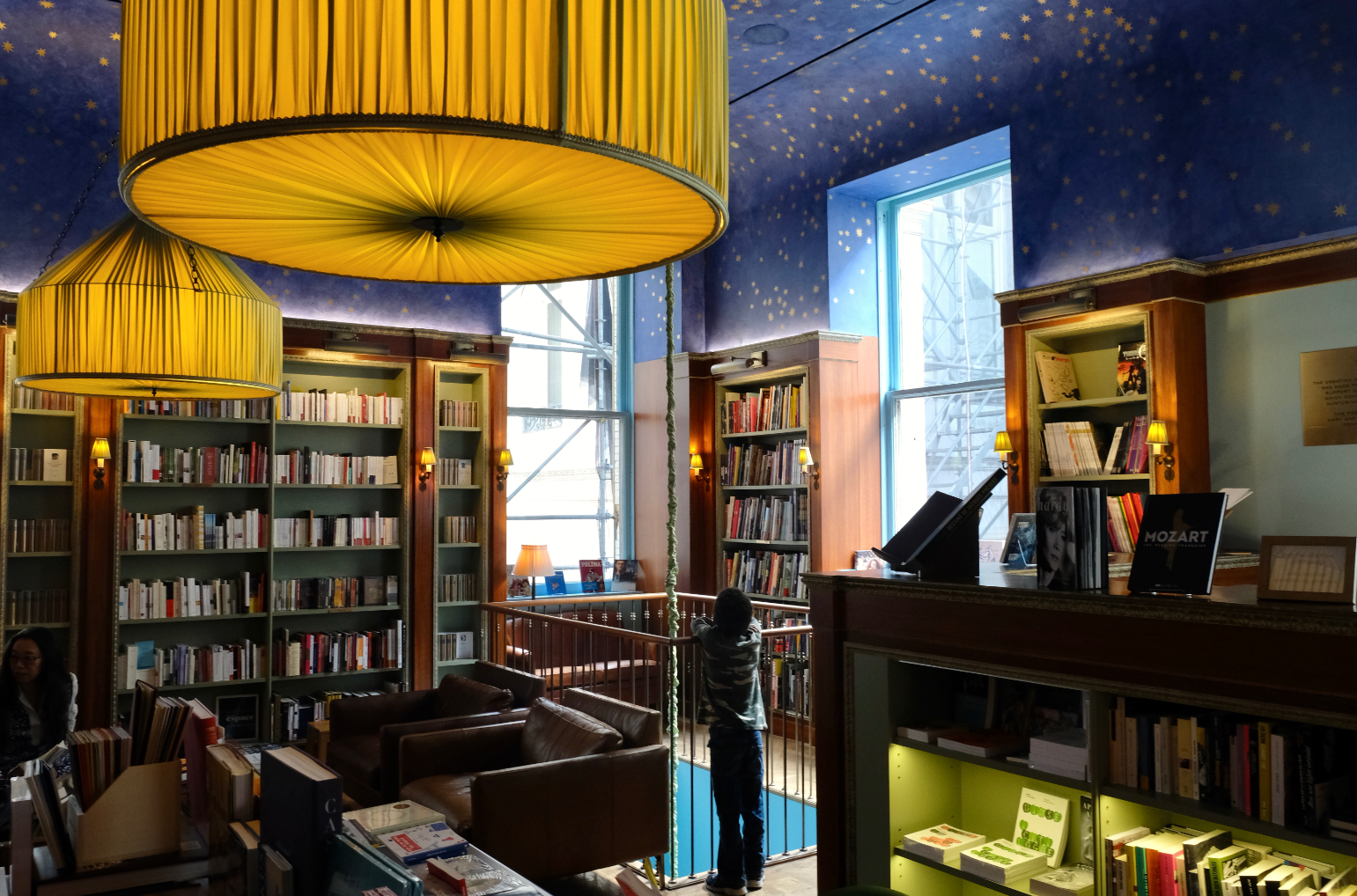
One of the finest rooms in the French government’s Fifth Avenue mansion had been turned into offices and storage. The Payne Whitney house was designed by Stanford White and finished in 1906; France bought it in 1952, at the urging of the anthropologist Claude Lévi-Strauss. Decades later, the cultural counselor Antonin Baudry came across old photographs of the interiors and noticed a library where no library remained.
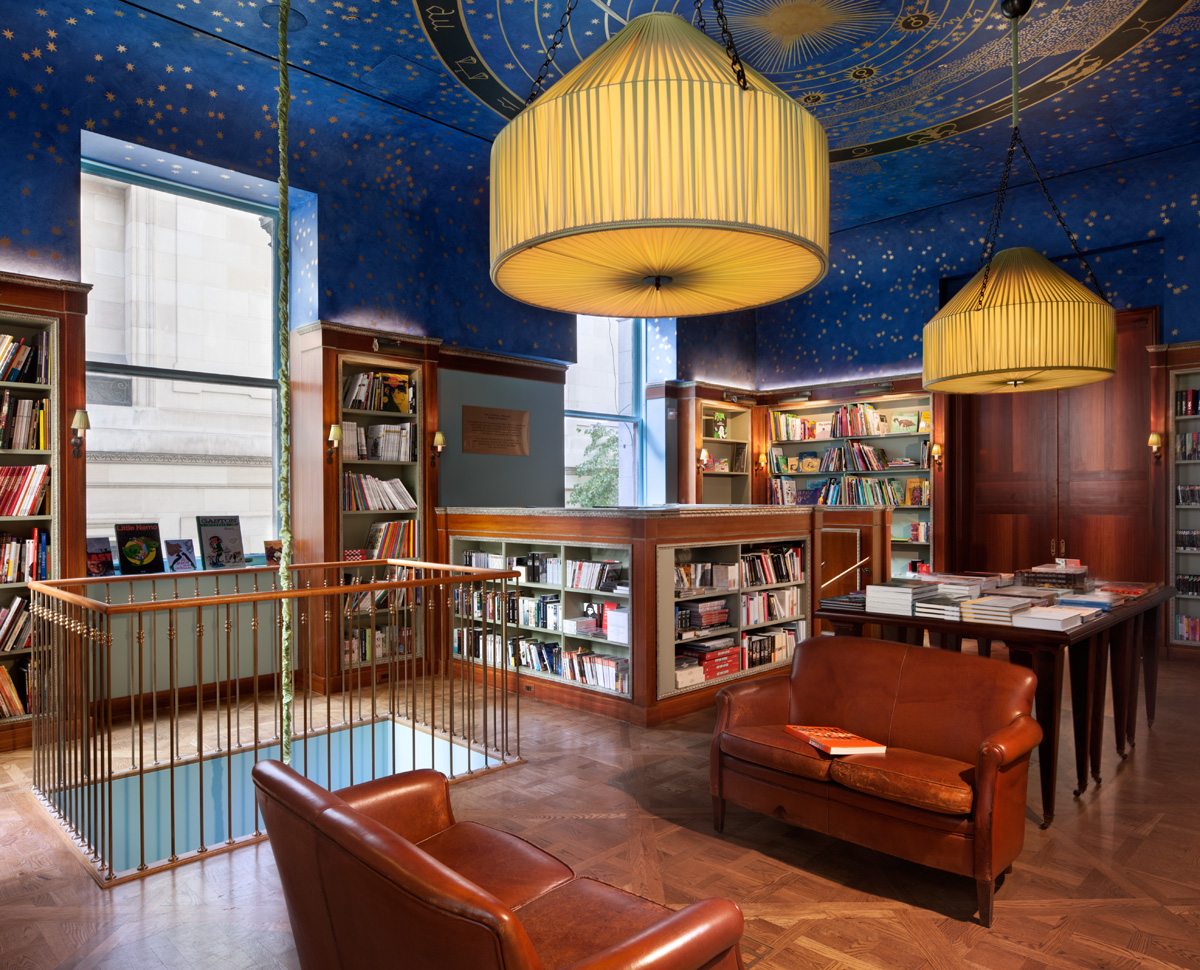
Albertine opened in September 2014, with its interiors by the designer Jacques Garcia, named for a character in Proust, with more than 14,000 titles in French and English, representing 30 French-speaking countries. The ceiling is hand-painted with constellations, modeled on Franz von Stuck’s music room at the Villa Stuck in Munich. Reading rooms with ceilings like this normally require an appointment and a letter of introduction. This one requires you to walk in off Fifth Avenue and sit down. It came ninth in our 2025 ranking, the only shop in that top ten you reach by walking into a building belonging to a foreign government.
Address: 972 5th Ave, New York, NY 10075, United States
Opening hours:
– Thursday to Tuesday: 10AM – 6PM
– Wednesday: Closed
Tianjin Zhongshuge, Tianjin, China
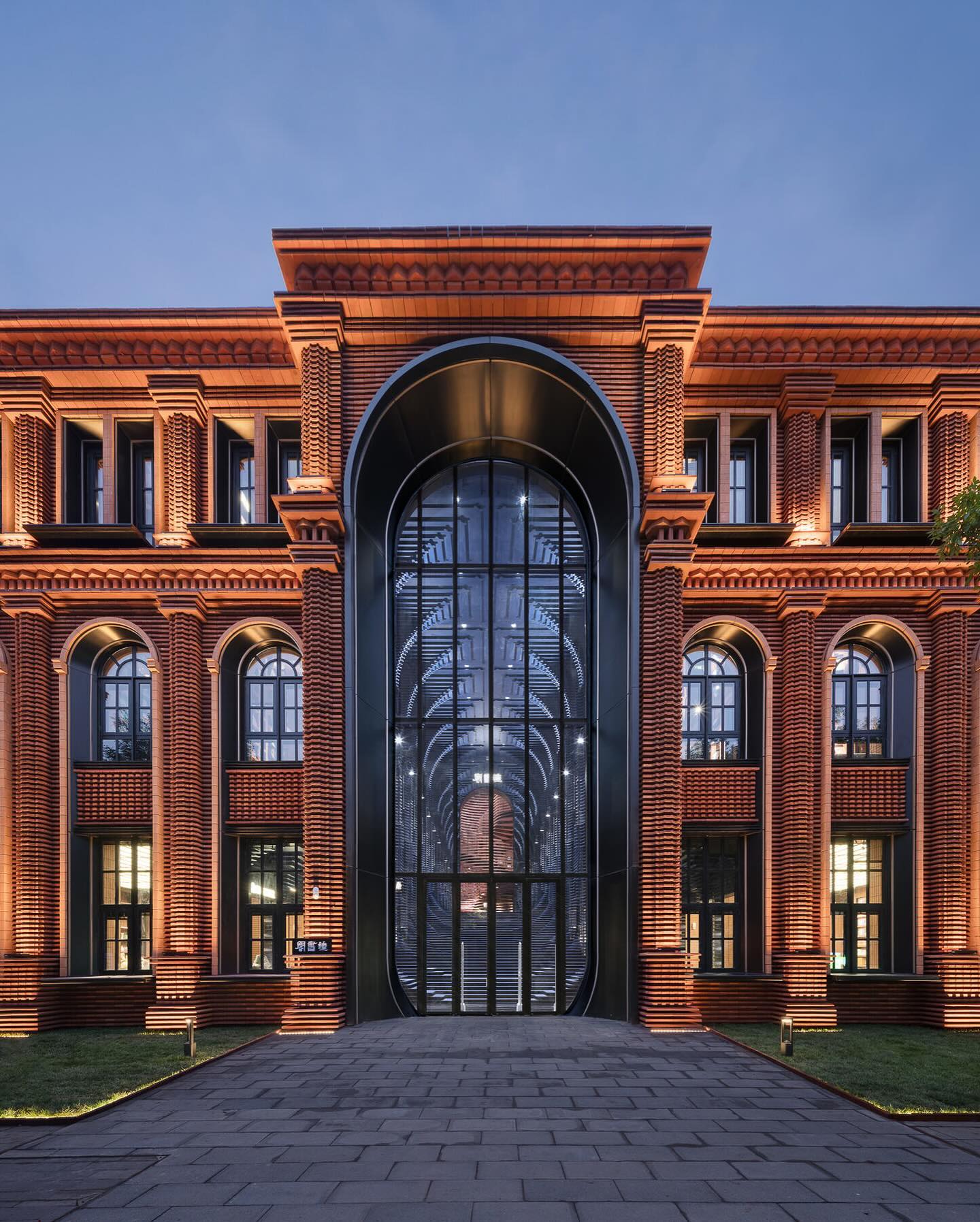
Four hundred thousand bricks, every one of them shaped for this building alone. Completed in September 2024, the building sits in Tianjin’s Italian-style district, the former concession, where the surrounding blocks are built of century-old red brick. X+Living, led by Li Xiang, replaced an out-of-place modern building with just two materials: red brick and dark blue steel, then made those two materials do everything: façade, arches, shelves, steps, seating. The result spans about 1,800 square meters across three floors.
It was shortlisted for the Dezeen Awards 2025 and won the Best of Best prize for retail architecture at the ICONIC AWARDS 2025, where the jury called it a “cathedral for books.” There is no decoration anywhere in it. Everything holding a book up is also holding the building up.
Address: No. 39 Minzu Road, Hebei District, Tianjin, China — inside Tianjin Italian Style Town
Opening hours:
– Monday to Sunday: 9:30AM – 10PM
Dujiangyan Zhongshuge, Chengdu, China
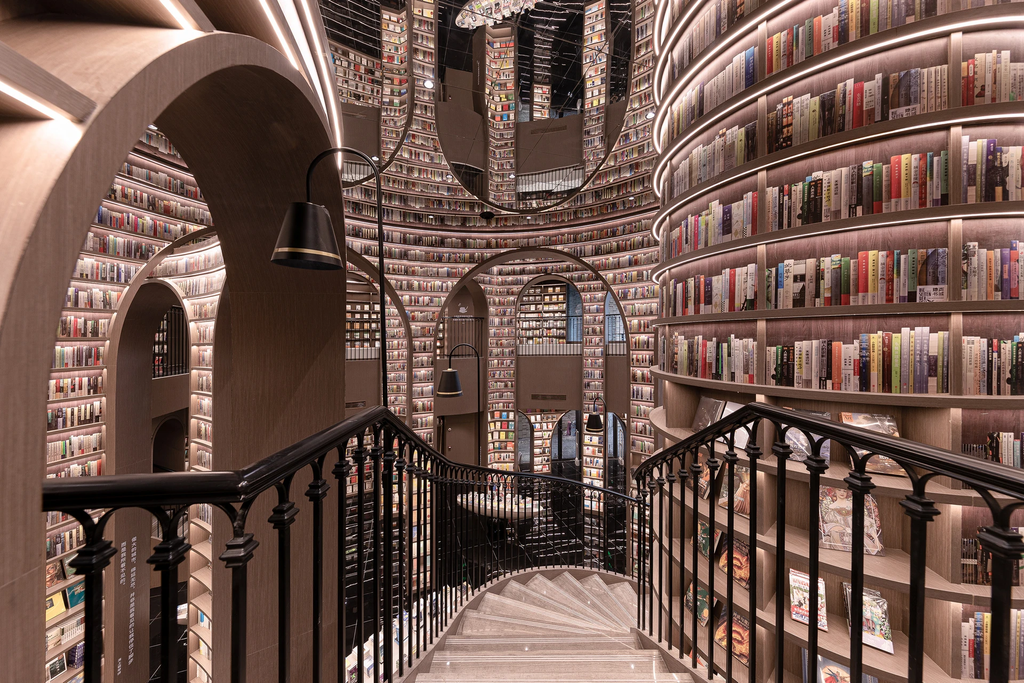
An hour west of Chengdu, the same studio built the opposite thing: a bookshop that is largely an illusion. It opened in autumn 2020 across roughly a thousand square meters. A mirrored ceiling completes every arch into a full circle, and the polished black tile floor turns the reading tables into boats at their moorings. The stepped- shelf walls follow the weirs of the Dujiangyan irrigation system, begun around 256 BC, and still steer the Minjiang River across the Chengdu Plain without a dam.
In the children’s area, the shelves are shaped like bamboo. The highest shelves, the unreachable ones, are papered with printed spines, and all 80,000 titles sit within arm’s length. The fake books are the honest part of the design. The spectacle is put exactly where you can only look, and the reading is put where you can only touch. Our readers put it sixth in the world in 2025, and it’s the newest shop in that top ten by six years.
Address: China, Sichuan, Chengdu, Dujiangyan City, Yulei Rd, 玉玺路51 邮政编码: 611830
Opening hours:
– Monday to Sunday: 10AM – 9PM
TSUTAYA BOOKSTORE Noritake Shinmachi, Nagoya, Japan
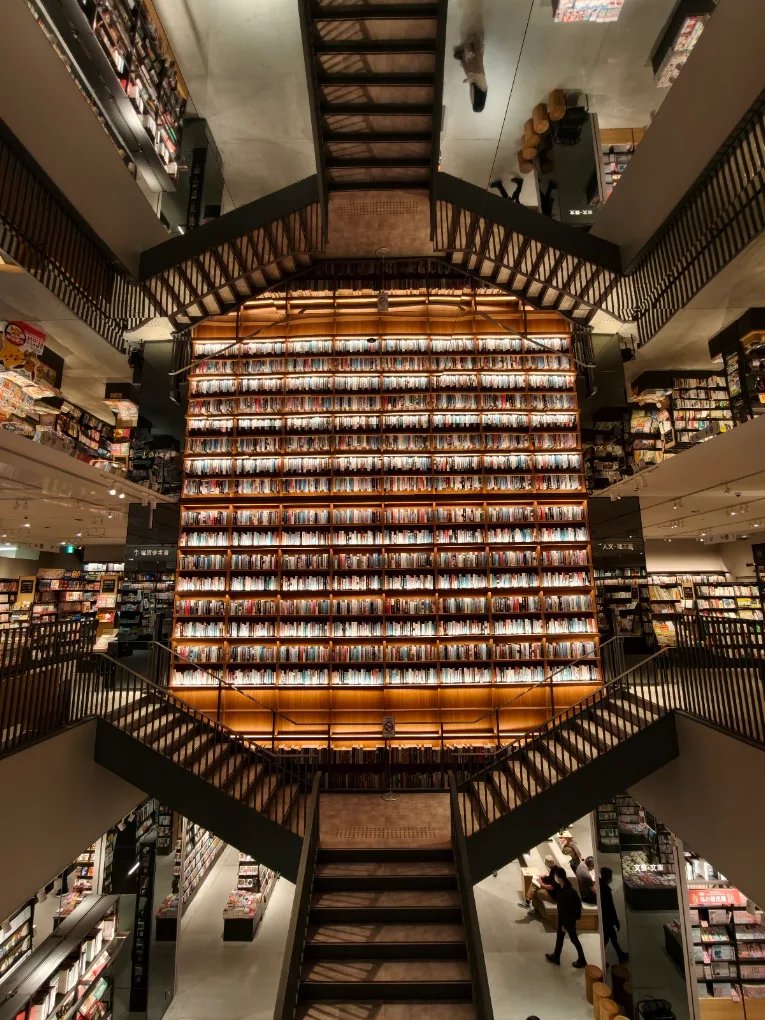
People come to this one for a wall. It opened in October 2021 inside AEON Mall Nagoya Noritake Garden, on the grounds of the old Noritake porcelain works west of Nagoya Station. Twelve tiers of shelving rise in front of a staircase that splits left and right, lit from above and below at every second tier so the rows read as depth rather than flatness. The ceiling is mirror-finish aluminium, so shelves and stairs appear again upside down and the room seems twice its height. Visitors now arrive from overseas having seen the photograph first and the city second.
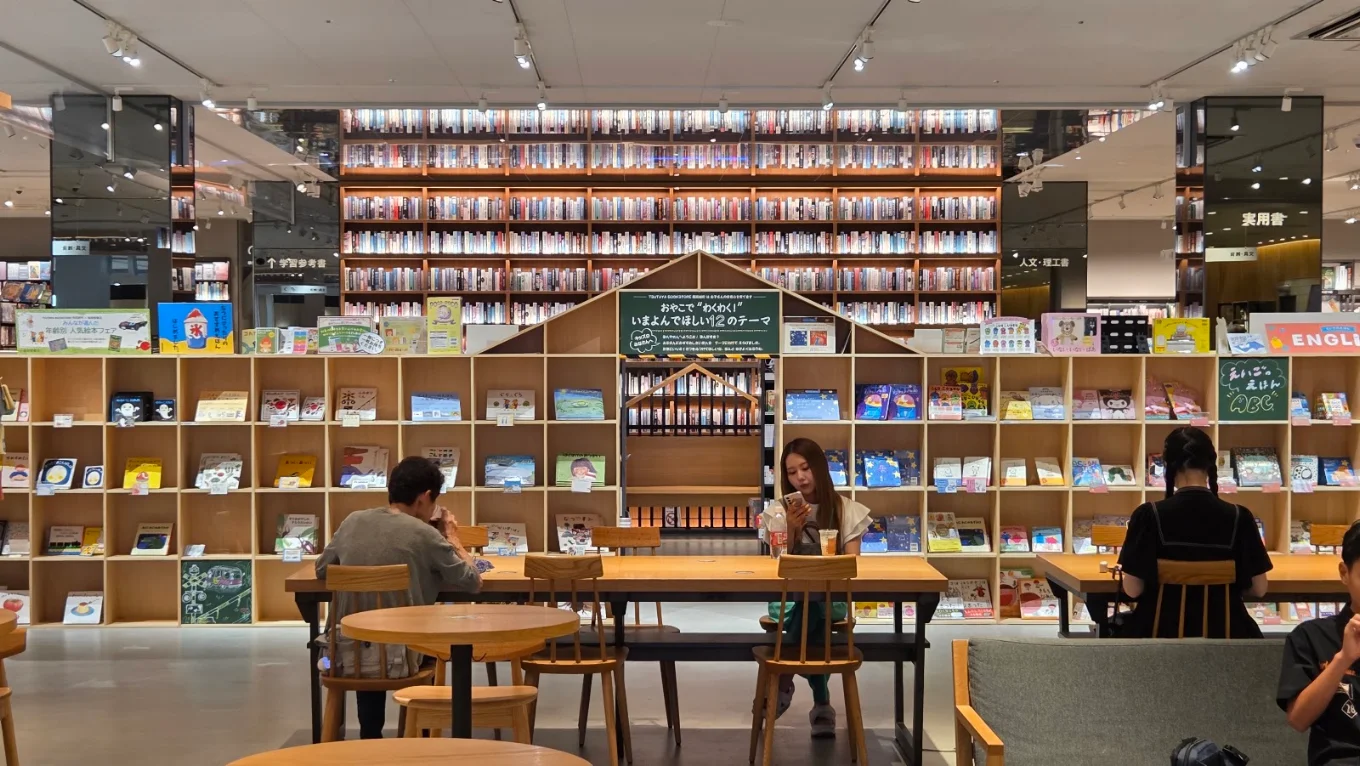
The brief was oddly specific for a mall unit: the bookshop in Japan that children most want to be taken to. Roughly 2,470 square meters over two floors, fiction and manga below, children’s books and stationery above, with a Starbucks taking 60 seats where anything off the shelves can be read before you buy it. The mall’s most photographed object turned out to be a bookcase, and the correct way to see it is to sit underneath it for the afternoon.
Address: Japan, 〒451-0051 Aichi, Nagoya, Nishi Ward, Noritakeshinmachi, 3 Chome−1−1番17号 イオンモール
Opening hours:
– Monday to Sunday: 10AM – 9PM
Yanjiyou Capsule Bookstore, Qinglongwu, China
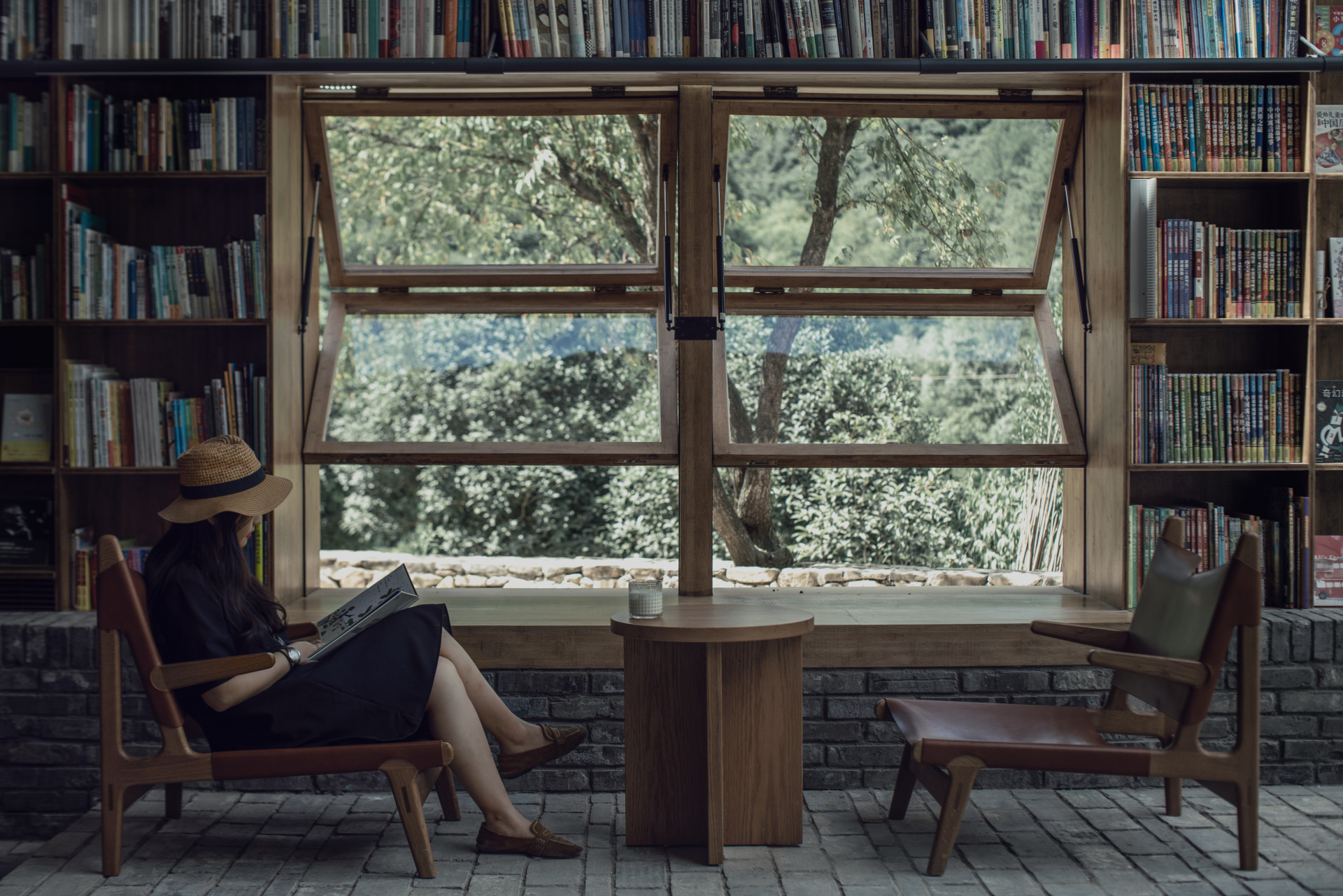
Finish at the far edge of the idea: a bookshop you can sleep inside. In the forested hills of Tonglu county, Zhejiang, an old timber-and-mud farmhouse measuring 232 square meters rises to a height of 7.2 meters. Atelier tao+c pulled out the floors and partitions, left the ground level open as a library the village actually uses, and hung two independent structures above it, each holding ten sleeping capsules, walled entirely by bamboo bookshelves.
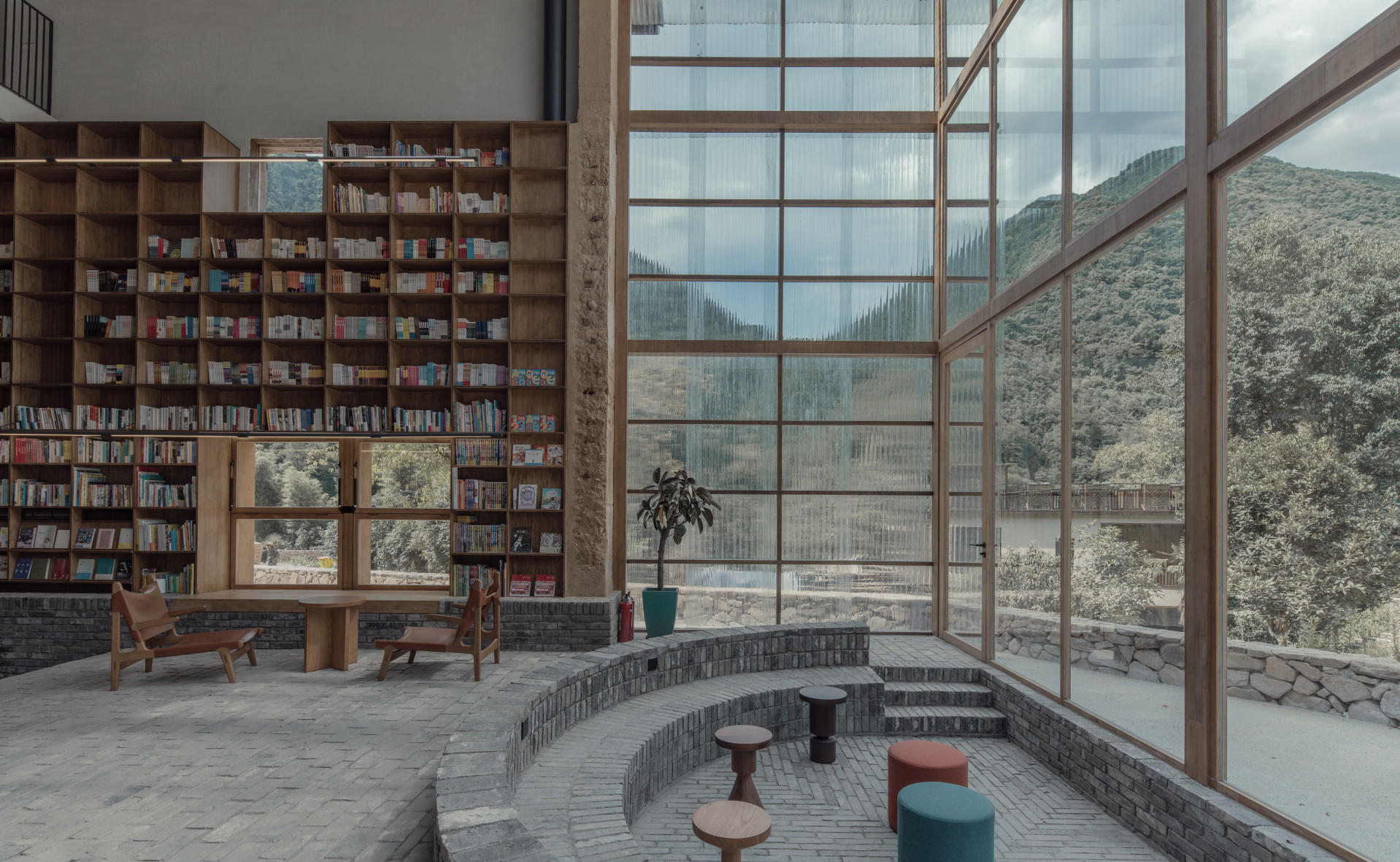
Every capsule window is aligned to frame a view back down into the stacks. The studio says that, after dark and lit from within, “the building itself becomes a lighthouse.” It won the interiors project of the year at the Dezeen Awards 2020. Twenty beds, one library, a working village outside the door. You don’t visit this bookshop and leave. You visit it and go to bed in it.
Address: Qinglongwu Village, Tonglu, Zhejiang Province, China
Opening hours:
– Varies seasonally, please check before travelling
The Room Was the Point
None of these buildings makes sense as a way to sell books. A church nave, a theatre dome, four hundred thousand hand-shaped bricks—you’ll never earn that back on margin. They make sense as a different bet: that people will still travel somewhere to linger, talk to a bookseller, and leave with the novel they weren’t looking for.
The bet keeps paying. Maastricht’s shop was rescued by its customers. Porto’s is a national monument. Tonight, in a Zhejiang farmhouse, twenty people are asleep in a library.
The internet won the transaction, comprehensively and permanently. It was never in the running for the afternoon. Buy the book online if you want. The room is the one thing nobody can ship.
